


Outline
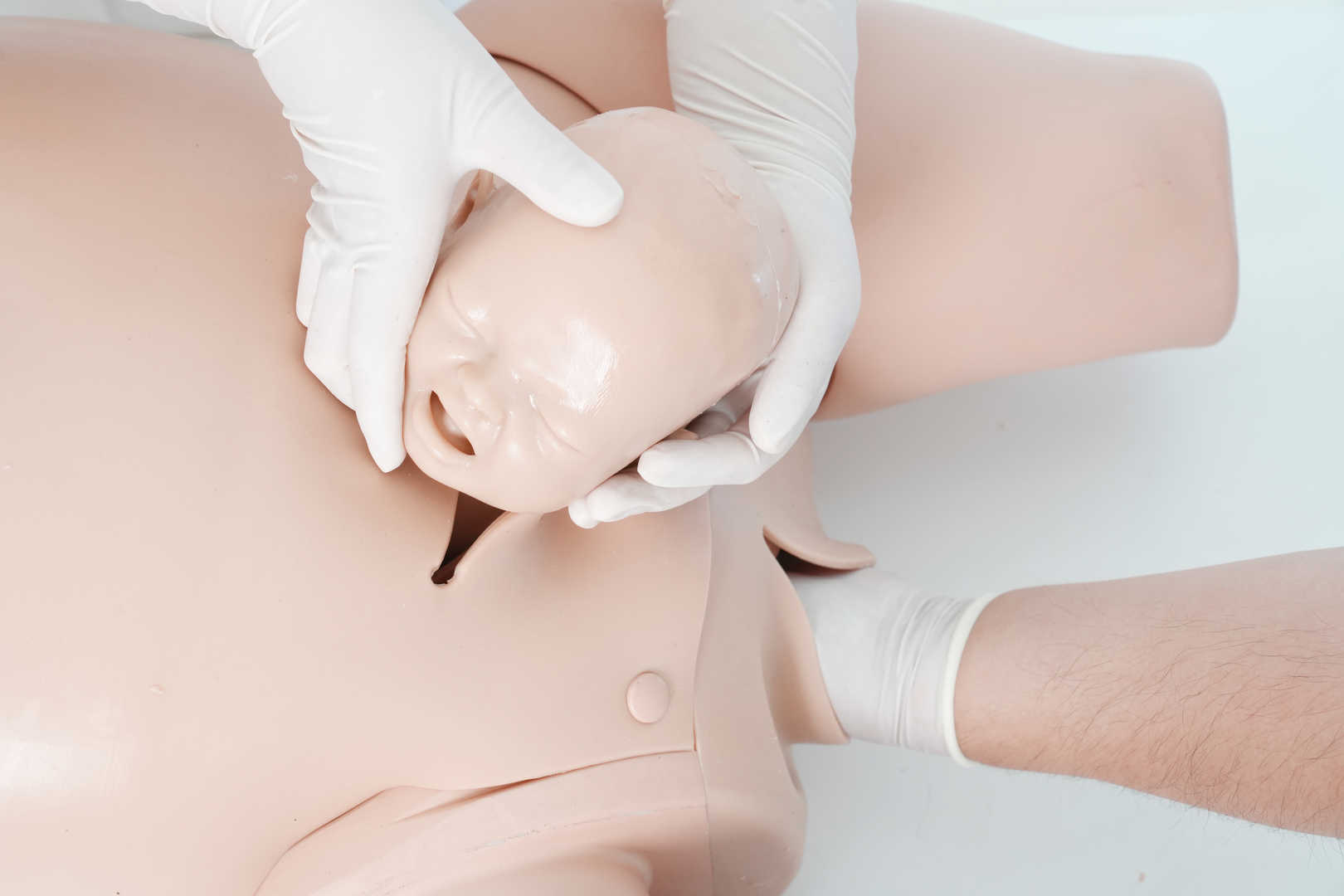
It’s a true-to-life lower half-body of a female with a full-term infant. Anatomically correct vaginal canal, ischial spine and pubic joint that facilitate training with anatomical understanding. Suited for all learners in both professional education and healthcare providers.
Skills Gained
· Delivery of fetus
· Delivery of the placenta
· C-section delivery
· Clamping and cutting of the umbilical cord
· Insertion of urinary catheter
Features
· Realism:
1) The structure is very similar to the real vaginal canal.
2) Bony landmarks such as pubic symphysis, ischial spines, apex of coccyx, sacrum, anterior superior iliac spine, sacral promontory, etc.
3) A full-term newborn with palpable fontanel, cranial suture, inferior scapular angle, spine of the scapula, and movable neck and limb joints.
· Anatomy:
1) Accurate anatomical structures and obvious landmarks from the lower part of xiphoid to upper thighs.
2) The bilateral hip joints are flexible and can realize flexion, adduction, abduction, internal rotation and external rotation, and it can be positioned in the lithotomy position and McRoberts position.
· Key Features:
1) Multiple fetal positions are supported, such as cephalic, breech, and transverse lie.
2) The fetus’s hands present a fist posture, with the neck joints moving freely in all directions without resistance. Limbs are in a naturally slightly flexed position.
3) Built-in bones in arms, thighs, lower legs, and feet, which ensures that pulling on the lower limbs during simulated delivery training for abnormal fetal positions does not cause excessive deformation of the fetus.
4) Two Labor Statuses for C-section:
Status 1: deeply impacted fetal head at 5-6 cm cervical dilation
Supporting intravaginal fetal head disimpaction technique or assisted delivery with single-blade obstetric forceps
Status 2: undilated cervix
The fetal head can be slowly delivered from the uterine incision, and fundal pressure can be applied to assist delivery of the head from the incision. If a high floating head is present, simpson forceps can be used to assist delivery.
5) Realistic amniotic sac structure. Simulated amniotic fluid can flow out after manual rupture of membranes.
6) The urethra can be inserted with a F14-F20 gauge catheter to a depth of 4-6 cm.
7) It comes with simulated umbilical cord and placenta. The umbilical cutting and clamping can be performed.
8) The model has a carrying handle for easy carrying. The built-in straps and non-slip design can be fixed on the desktop and is not easy to move during operation.
9) The abdomen wall supports quick removal without tools. There is a simulated uterus in the abdominal cavity, with an approximately 12cm surgical incision in the lower uterine segment, supporting the delivery of the presenting part of the fetus, the entire fetus, umbilical cord, and placenta through this incision.

Stock code :833047
Address:2nd & 3rd Floor, West 6th Building, 18 West HaiTai Road, Tianjin, China
Postcode:300384
Phone:4006-355-510
+86-22-83711066
Fax:+86-22-83711065
Email:info@tellyes.com

 Obstetric