


Outline
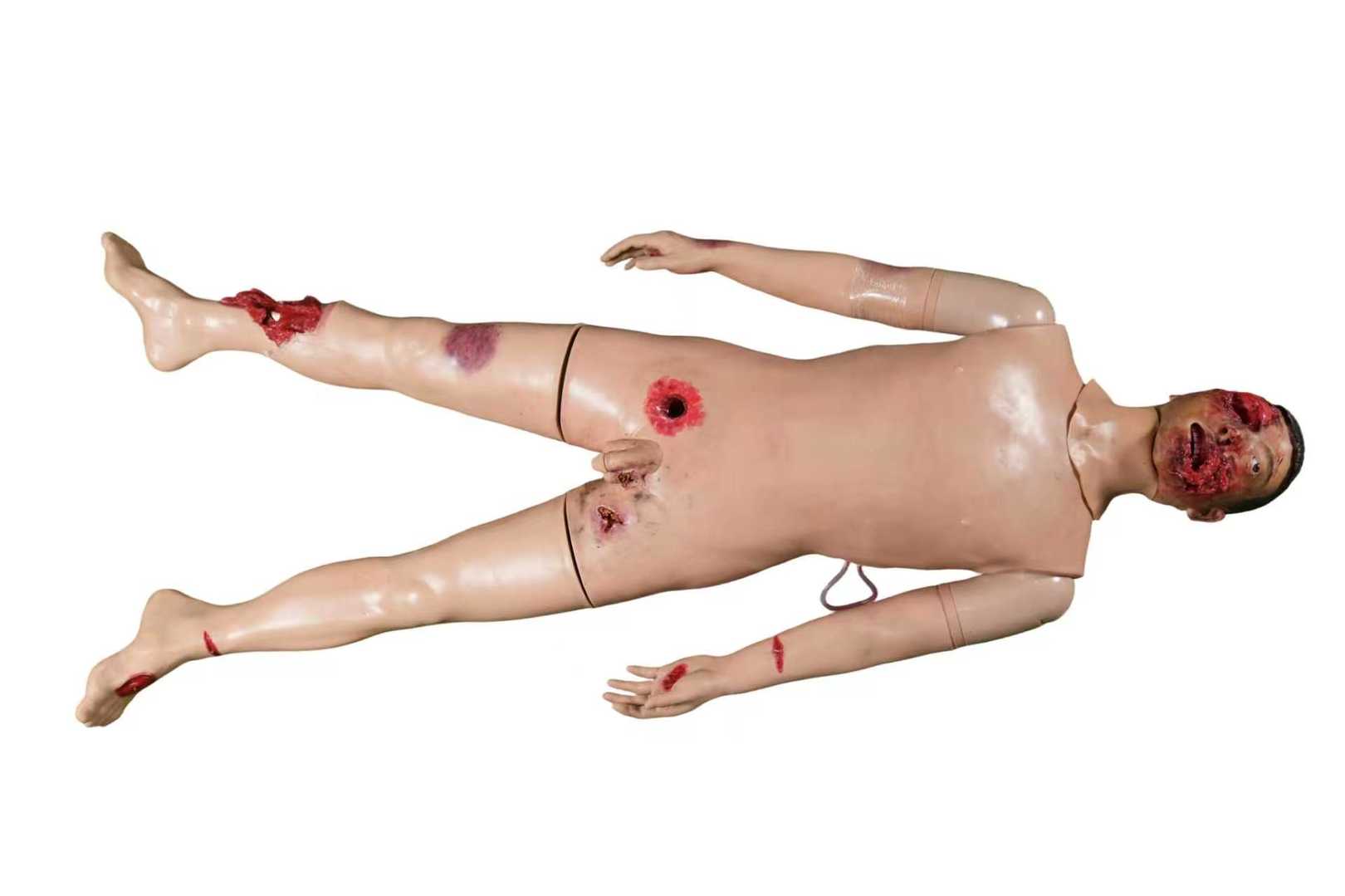
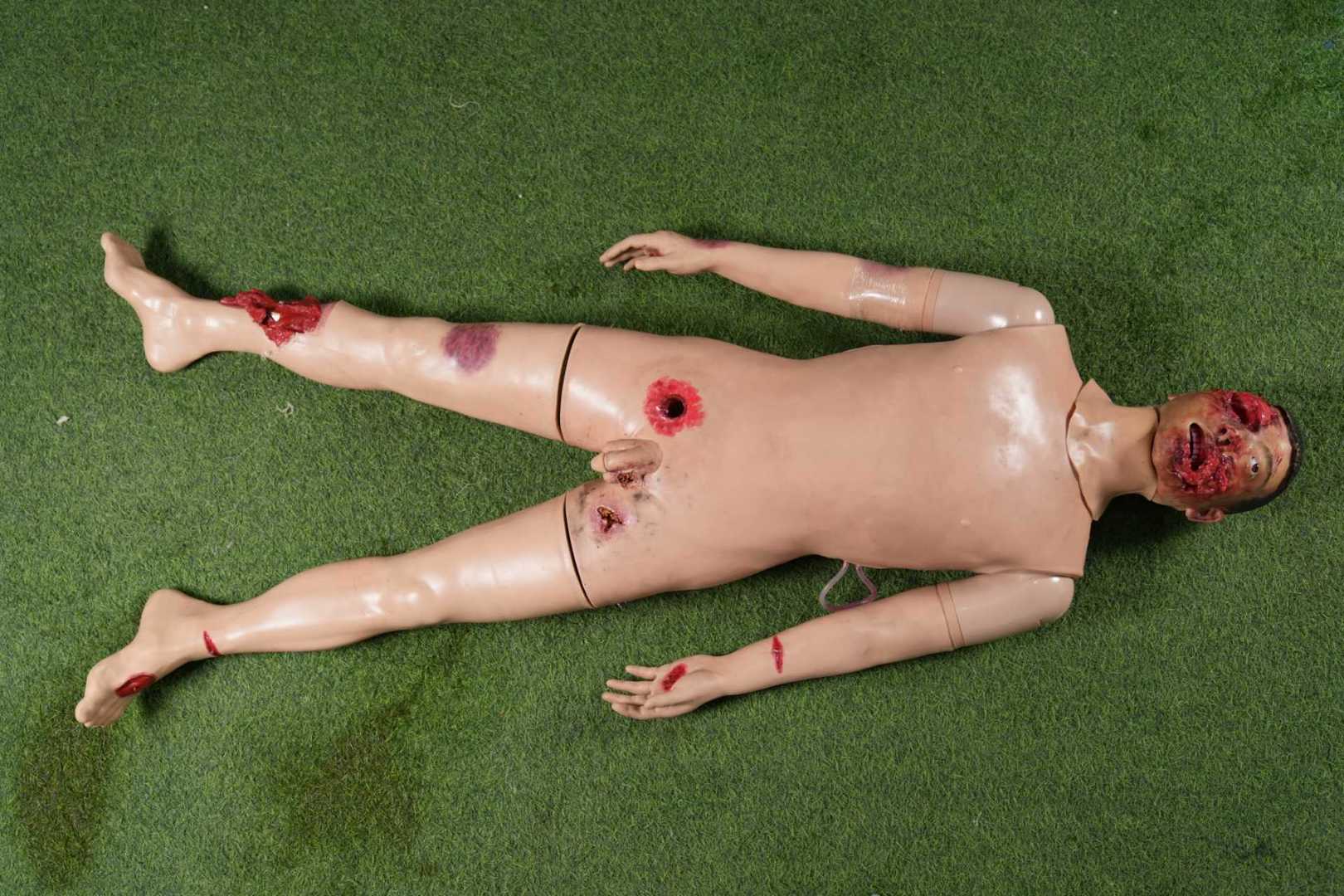
This full-body manikin is designed for trauma management and combat self-aid & buddy-aid training and assessment, including ventilation, resuscitation, hemostasis, bandaging, immobilization and handling. It features multiple simulated injuries, and stress responses (amputation leg) with involuntary movement and bleeding.
Skills Gained
· Anatomical familiarity
· Airway management
· Needle & surgical cricothyrotomy
· Tracheotomy
· Needle decompression
· CPR skills
· Trauma management
· Multiple-position hemostasis
· Fracture handling and patient transfer
Features
Anatomy:
· The male manikin is approximately 175cm ×54cm ×252cm. Its weight is approximately 55 kg.
· Complete and realistic airway structures: oral cavity, nasal cavity, pharynx, trachea, left and right main bronchus; teeth, tongue, palatoglossal arch, palatopharyngeal arch, tonsil, glottis, epiglottis and uvula.
· Usability:
· Full-body bionic bone structure with steel connections for enhanced durability.
· Wireless design with a remote control range within 100 meters.
· Built-in battery pack with over 8-hour runtime.
Key features:
1. Airway management:
a) Head-tilt/chin-lift & Jaw-thrust for airway opening. OPA, NPA, ETT, LMA and laryngoscope for airway establishment.
a) Supporting BVM, mouth-to-mouth, and ventilator-assisted ventilation, chest rise can be observed. When the endotracheal tube is inadvertently inserted into the esophagus, gastric distension can be observed after performing ventilation.
b) Palpable cricoid cartilage and thyroid cartilage facilitate needle & surgical cricothyroidotomy, and tracheotomy. The modules are replaceable for repeated use.
c) Simulation of tension pneumothorax supports puncture at second intercostal space at the midclavicular line bilaterally. Successful puncture by syringe comes with a sensation of loss of resistance, and the plunger of syringe being pushed up by automatic airflow can be observed.
d) The puncture module is durable, withstanding at least 400 punctures without air leakage.
2. Hemorrhage & hemostasis:
a) 2 bleeding patterns: Arterial and venous bleeding with adjustable volume and rate. The range of pulse rate is 50-110 BPM.
b) 11 remote-controlled bleeding sites: Forehead bleeding (Superficial temporal artery), facial bleeding (Infraorbital artery), maxillary bleeding, shoulder bleeding, forearm bleeding, palm bleeding, wearable abdominal bleeding with intestinal leakage, groin injury, calf bleeding, dorsalis pedis bleeding, and left leg amputation bleeding.
c) 2 maxillofacial trauma types: Penetrating wounds and superficial wounds with hemorrhage.
d) Internal bleeding control system with 1.5L maximum bleeding volume.
e) Hemostasis techinques:
· The integrally molded gunshot wound in the groin can bleed and achieve hemostasis by packing;
· Hemostasis can be achieved by applying pressure on facial artery, superficial temporal artery, subclavian artery, common carotid artery, brachial artery, ulnar artery, radial artery, anterior tibial artery, and dorsalis pedis artery for hemostasis. Arterial pulsation is palpable proximal to the bleeding site.
· Lower limb amputation can be simulated with traumatic stress response(involuntary movement) and bleeding. Hemostasis can be achieved by tourniquet application.
3. CPR
a) Chest compression can be performed. when the compression depth exceeds 5 cm and the compression position is correct, the prompt sound can be triggered.
4. Bandaging
a) Suitable for various bandaging techniques: Circular bandaging, oblique bandaging, spiral bandaging, spiral-reverse bandaging, figure-of-eight bandaging, and recurrent bandaging.
a) Bandaging on different sites: Head, neck, jaw, chest, abdomen, axilla, groin, arm, amputation leg and calf.
5. Immobilization:
a) 2 jaw fractures sites: Maxillary fractures (Le FortⅠfracture and maxillary defect), mandibular fractures (Single linear fracture, comminuted fracture and mandibular defect).
a) Long bones fractures: Humeral shaft fracture, distal ulna and radius fractures (Upper limb), femoral fracture, tibia and fibula fracture (Lower limb). The fractured ends can be palpated with bony friction, supporting the training of fracture reduction and splinting skills.
a) Fractured maxillary and mandibular bones with intact dentition and gingival anatomical structures for arch bar fixation and maxillary suspension.
b) It can simulate immobilization and transfer after spinal cord injuries. A cervical collar can be used for immobilization.
6. Handling
a) Supports multiple handling techniques.
b) Multiple body positions available due to flexible joints: Supine position, lateral position, prone position.
c) The lower limbs support quick tool-free changing.

Stock code :833047
Address:2nd & 3rd Floor, West 6th Building, 18 West HaiTai Road, Tianjin, China
Postcode:300384
Phone:4006-355-510
+86-22-83711066
Fax:+86-22-83711065
Email:info@tellyes.com

 Trauma & First Aid